
Yes. An induction cooktop does not burn gas, but the food you cook still produces smoke, airborne grease, steam, moisture, particles and odors.
The main difference is that induction does not create the combustion byproducts associated with burning natural gas. That can reduce certain pollutants and the amount of excess heat entering the kitchen, but it does not eliminate the need to manage what cooking itself releases into the air.
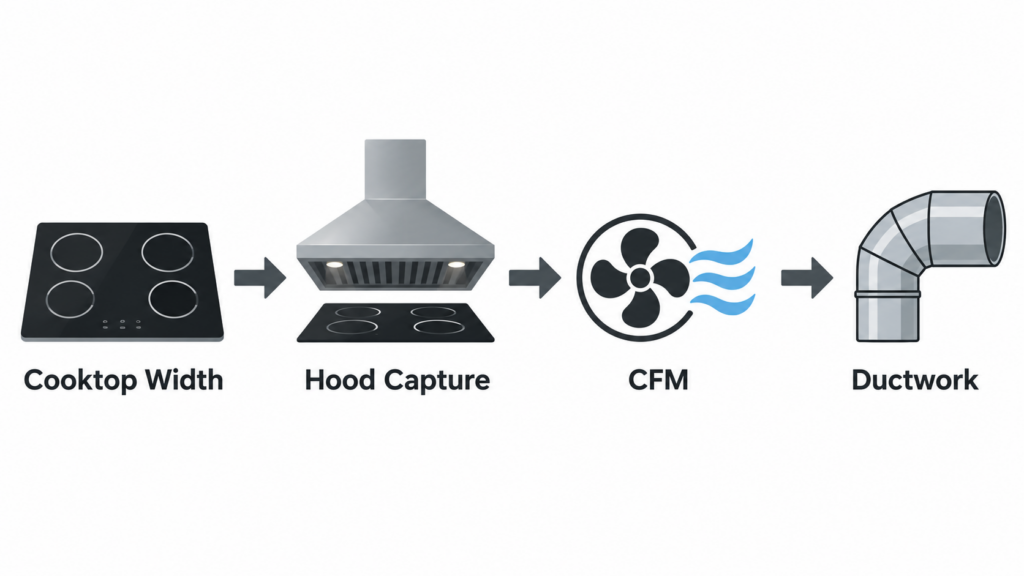
Modern Aire therefore approaches induction ventilation much like other cooking systems: the hood should provide enough capture area and airflow for the size of the cooking surface and the way you cook.
“A common misconception is that because an induction range does not produce gas fumes, it does not need a range hood. Ventilation is still important for exhausting grease, smoke and cooking smells from the home.”
~ Collin Herman
That distinction matters, especially in open-concept kitchens where cooking air can quickly move beyond the kitchen.
The misconception usually comes from one of induction’s biggest advantages: there is no open flame or fuel combustion at the cooktop.
That is an important difference from gas, but it only describes the heat source.
The food and cookware are still heated to cooking temperatures. Once oil, fat, sauces and other ingredients heat up, they can release smoke, moisture, grease aerosols, odors and airborne particles into the kitchen.
A useful way to think about it is:
Induction eliminates gas combustion. It does not eliminate cooking emissions.
This distinction becomes particularly important for homeowners switching from gas who assume their existing ventilation system can simply be removed.
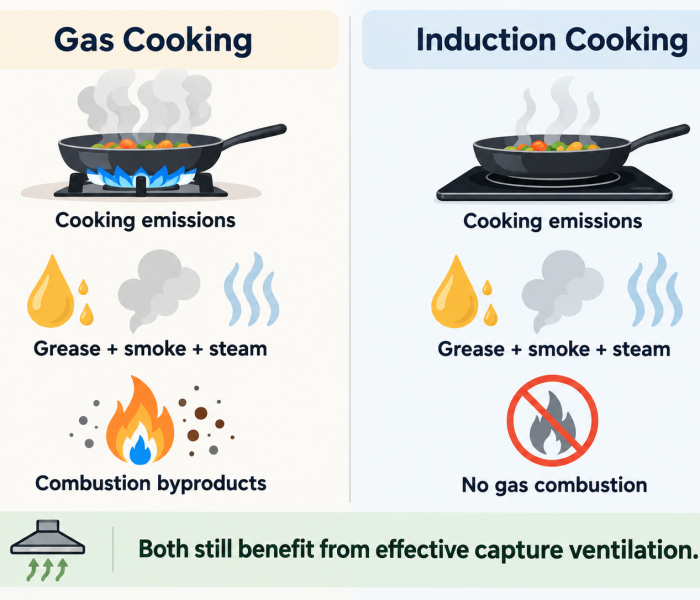
An induction cooktop heats cookware directly rather than creating a flame underneath it. That makes induction efficient, but once the pan heats up, the cooking process can still generate:
Consumer Reports similarly notes that particulate matter and other cooking-related pollutants can form whether someone is using gas, electric, or induction, which is why effective ventilation remains relevant across cooking technologies.
This is why range hood performance should not be evaluated solely by asking whether the appliance burns gas.
A properly planned hood captures cooking air close to where it is generated, before it spreads farther into the home.
For homeowners dealing specifically with lingering odors, read Why Does Your Kitchen Still Smell After Cooking?
The overall planning process is fairly similar, but the heat source changes part of the calculation.
Gas cooking creates combustion products in addition to emissions generated by the food. Induction eliminates the combustion source and can therefore sometimes operate effectively with somewhat lower airflow.
However, Modern Aire does not recommend dramatically changing the ventilation plan solely because a homeowner has chosen induction.
Modern Aire Team Insight:
“Ventilation planning for induction is fairly similar to gas. The customer may be able to use a slightly lower amount of CFM, but the recommendations do not vary significantly.”
What should not change dramatically is the physical size of the hood.
Modern Aire recommends that a hood be at least as wide as the cooking surface and up to 6 inches wider to provide adequate capture. The cooking plume still needs somewhere to go, regardless of whether the pan is sitting over induction coils or gas burners.
For detailed width, depth and mounting guidance, see Modern Aire’s How to Size a Range Hood for Your Kitchen guide.
Modern Aire recommends using approximately 200 CFM for every 12 inches of electric or induction cooktop width as a starting point.
Induction Cooktop Width |
|
24 inches |
|
30 inches |
|
36 inches |
|
48 inches |
|
These numbers are starting points, not a universal answer.
The right airflow can also depend on:
Modern Aire’s team also recommends avoiding an unnecessarily undersized blower.
“The size of the hood should still be based on the size of the range. CFM may vary marginally with induction. With our variable switches, it is generally preferable to have airflow available when needed rather than not having enough.”
~ Collin Herman
Variable-speed control allows homeowners to use lower airflow during lighter cooking and increase ventilation for frying, searing or other higher-emission tasks.
That does not mean simply choosing the highest CFM possible. Ductwork, capture area and installation still need to support the blower.
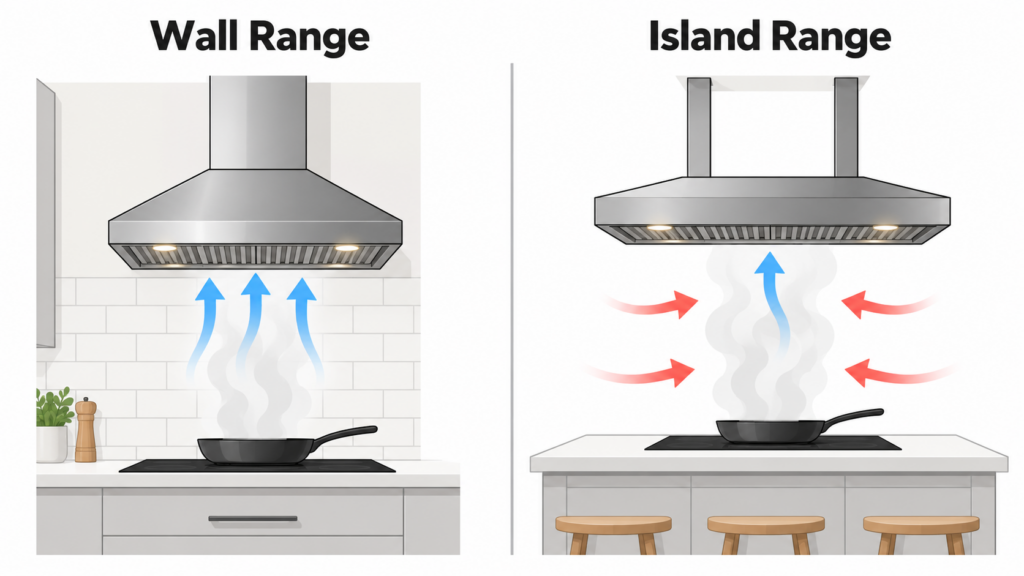
Yes, this is one place where kitchen layout becomes particularly important.
In a closed kitchen, walls help contain some of the cooking air. In an open-concept layout, smoke, grease and odors can move more easily into dining rooms, living areas and other connected spaces.
“Open-concept kitchens and island ranges are more dependent on appropriate ventilation because the area is less contained, allowing smoke, grease and cooking air to spread more easily throughout the space.”
~ Collin Herman
Island installations deserve similar attention because the hood does not have a wall behind the range helping contain the cooking plume. Air movement from people walking through the room, HVAC registers, doors and nearby windows can also influence capture.
For that reason, switching to induction should not automatically be used as a reason to make an island hood smaller or shallower.
The hood still needs to capture what is being cooked.
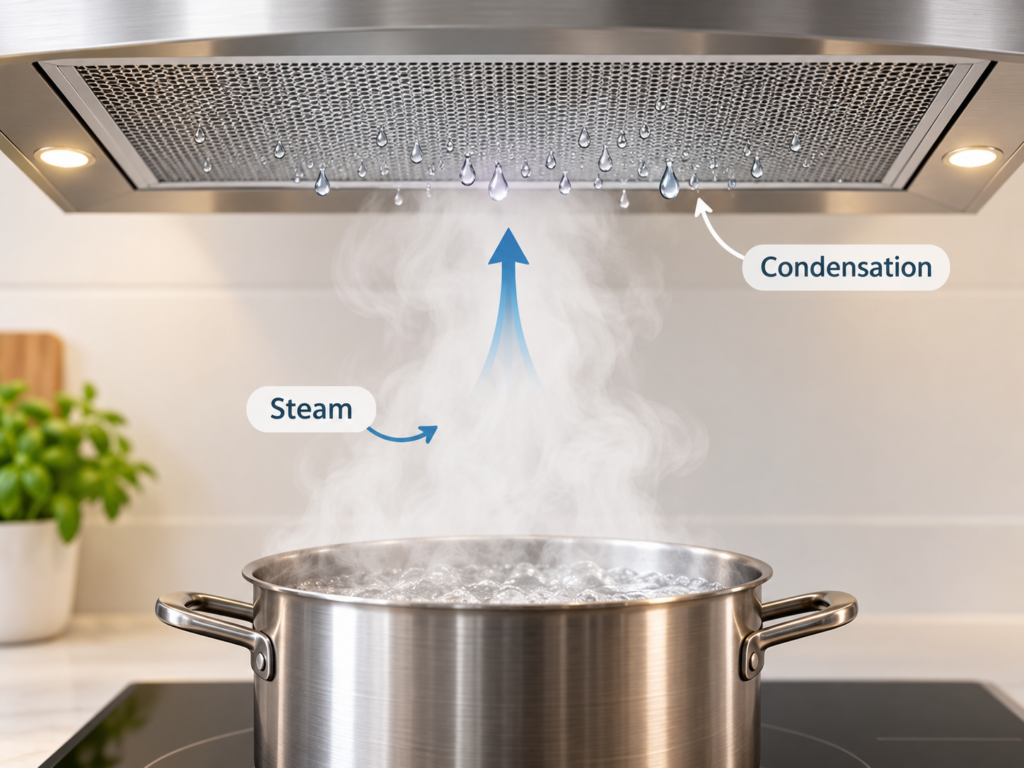
There is another difference homeowners may notice after switching to induction: condensation.
Because induction transfers energy directly to the cookware, it creates less residual heat around the cooking surface than gas or traditional radiant cooking. That means the underside of the hood and its filters may remain relatively cool.
When warm, moisture-heavy steam rises from a pot and reaches those cooler surfaces, water can condense.
This does not mean the range hood is causing the problem or is unnecessary. It demonstrates that induction cooking can still generate significant moisture that needs to be managed.
If condensation is persistent, review the hood operation, airflow, mounting and cooking conditions rather than assuming more CFM alone will solve it.
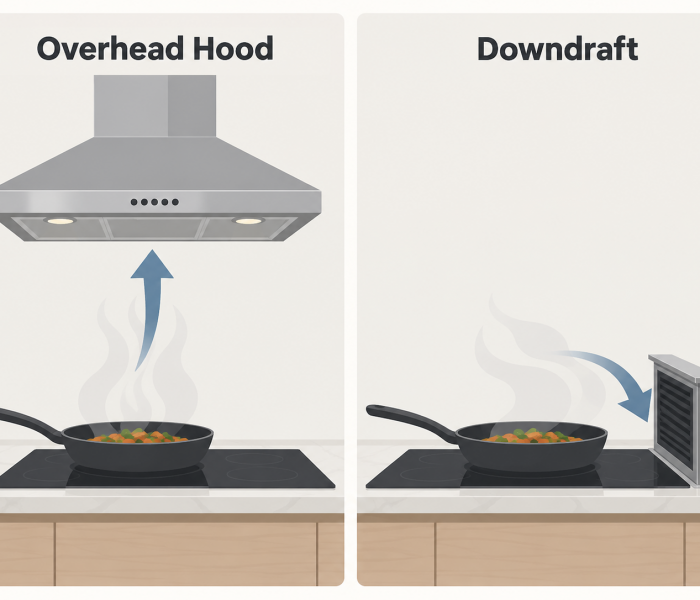
A downdraft changes where cooking air is captured, not whether ventilation is required.
Downdraft systems pull smoke, steam and grease toward an intake near the cooktop rather than capturing them as they naturally rise. This can make them less effective than a properly sized overhead hood, especially during frying, searing or high-heat cooking.
“Downdrafts are not nearly as efficient at removing grease and other cooking contaminants because they can miss a significant portion of what is released. They will not perform as well as an overhead range hood.”
~ Collin Herman
Before choosing an integrated downdraft system, consider:
The decision should therefore be overhead capture versus downdraft capture, not “ventilation versus no ventilation.”
If you already have an effective range hood, switching to induction does not necessarily mean the hood needs to be replaced.
Before changing the ventilation, review five things:
If you are also redesigning the cabinetry, moving the cooking surface or changing from a wall range to an island, treat the project as a new ventilation plan, not simply an appliance swap.
Induction changes how the cookware is heated, not the fundamental need to control what cooking releases into the room.
A well-planned range hood still helps capture:
Grease. Smoke. Steam. Moisture. Odors. Cooking particles.
For an induction kitchen, start with the cooking surface dimensions, understand how you actually cook, then match the hood’s capture area, blower and ductwork to the project.
Modern Aire offers wall-mount, island and fully custom range hoods with internal, inline and external blower options for kitchens across the U.S. and Canada.
Planning an induction kitchen or switching from gas?
Explore Modern Aire’s range hoods, motor options, or Find a Dealer to discuss the right ventilation setup before cabinetry and installation details are finalized.

A recirculating system may be an option when exterior ducting is not practical, but it works differently from a ducted hood. It filters the air and returns it to the kitchen rather than exhausting cooking air, moisture and heat outdoors. Consider your cooking habits and installation constraints before choosing between the two.
No special filter is required simply because the cooking surface uses induction. The appropriate filtration depends on the hood design and whether the system exhausts outdoors or recirculates air.
Modern Aire’s stainless steel baffle filters are designed to capture airborne grease before air moves farther through the ventilation system.
Often, yes. If the cooktop dimensions remain similar and the existing hood provides adequate capture, airflow and ducting, there may be no reason to replace it solely because the heat source changed.
Evaluate the entire setup before making the decision.
Using ventilation can still be helpful because boiling releases significant moisture into the kitchen, even though little or no grease or smoke may be produced.
The appropriate fan speed can be adjusted to match the cooking task rather than operating at maximum airflow every time.