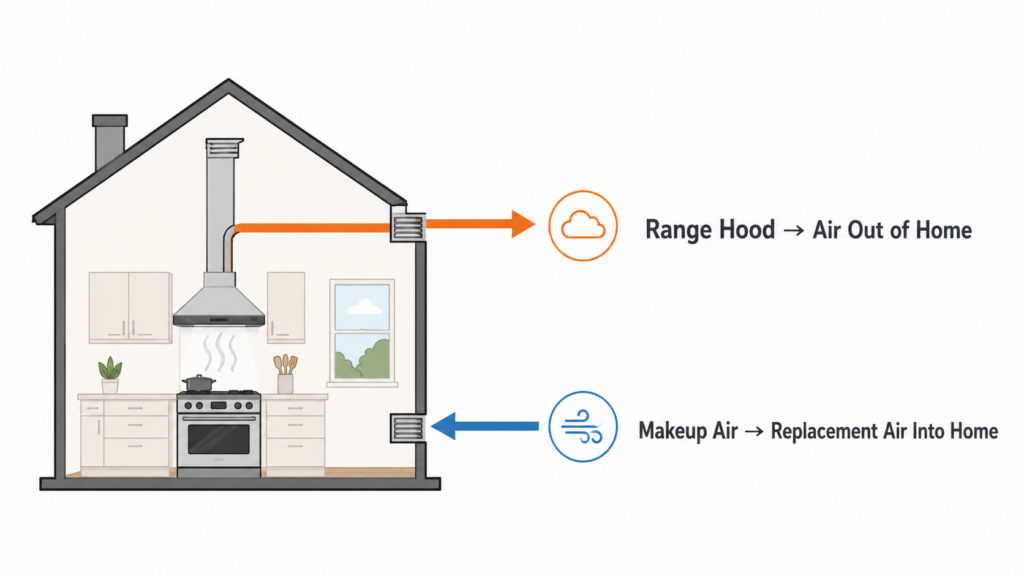
Makeup air is replacement air brought into a home to replace the air a ducted range hood exhausts outdoors.
Whether your kitchen needs a dedicated makeup air system depends on more than the range hood itself. Important factors can include:
Higher-CFM hoods deserve more attention because they remove more air, but there is no single CFM threshold that applies to every home or every jurisdiction.
Modern Aire recommends discussing makeup air with the builder, contractor, HVAC professional, or applicable local code authority before the hood and blower are finalized.
A ducted range hood pulls cooking air from the kitchen and exhausts it outdoors.
When air leaves the house, replacement air has to enter from somewhere.
Without a planned source of replacement air, that air may enter through uncontrolled openings in the building envelope. Health Canada explains that exhaust-only systems can depressurize a home, causing replacement air to enter through unintended pathways, such as cracks and openings.
A makeup air system provides a more deliberate way for replacement air to enter while the exhaust system operates.
A simple way to think about it is:
Range Hood → Exhaust Air Leaves → Replacement Air Enters
Makeup air is therefore not another range hood feature. It is part of how the home’s ventilation and pressure balance support the hood.
Ideally, before the range hood and blower are ordered.
This is particularly important during:
“Makeup air should always be discussed with the contractors, etc., as requirements are based on local ordinances.”
~ Collin Herman
Discussing it early gives the project team time to coordinate any required ducts, dampers, controls, electrical work, HVAC equipment, or wall and ceiling penetrations.
Waiting until cabinetry and finishes are complete can make those changes more difficult and expensive.
There is no universal CFM number that applies to every home.
This is one of the most important points for homeowners because online advice often reduces the subject to statements such as:
“Anything over 400 CFM needs makeup air.”
or:
“Makeup air only matters above 600 CFM.”
The actual answer depends on the project.
Modern Aire typically sees makeup air become more relevant at CFM levels above approximately 600, but the team emphasizes that this is location-dependent.
That should be treated as a planning signal rather than a universal code threshold.
For example, the current 2024 International Residential Code Section M1503.6 includes a makeup air provision for exhaust systems above 400 CFM when specified conditions involving certain fuel-burning appliances inside the dwelling’s air barrier are present.
That does not mean every range hood above 400 CFM everywhere requires the same makeup air system.
Canadian homeowners should also not assume that a U.S. IRC threshold applies to their project. Ontario, for example, uses the National Building Code of Canada 2020 together with Ontario-specific amendments.
The practical takeaway is:
Use CFM as a reason to ask the makeup air question, not as the complete answer.
Tighter homes have fewer uncontrolled openings through which replacement air can naturally enter.
“Newer homes with tighter sealing more commonly require makeup air.”
~ Collin Herman
That does not mean every newly built home automatically requires a dedicated makeup air system.
It means airtightness makes air balance more important.
In a leakier house, replacement air may enter naturally through gaps in the building envelope. In a tightly constructed house, there are fewer pathways for that air to enter while a powerful range hood is operating.
This is why two homes with the same 600, 900, or 1,200 CFM range hood may require different planning.
One may have considerably more natural air leakage than the other.
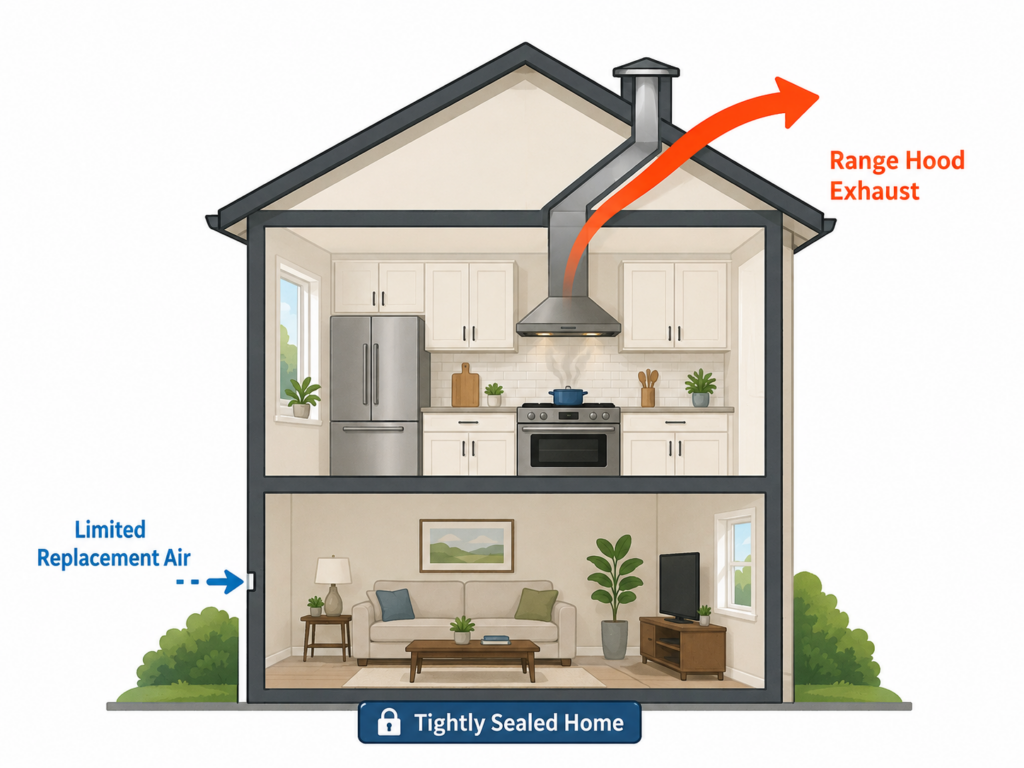
The house can become negatively pressurized relative to the outdoors.
Imagine removing air from a closed container without letting enough air back in.
A similar effect can occur in a tightly sealed home when a powerful exhaust system removes air faster than replacement air enters.
Possible effects can include:
Health Canada identifies depressurization and backdrafting of combustion appliances as issues that should be considered where adequate replacement air is not available.
Possible clues can include:
These symptoms do not prove that a dedicated makeup air system is required.
They indicate that pressure balance and replacement-air pathways may deserve professional evaluation.
Do not use a candle, flame, or other DIY method to test whether combustion equipment is backdrafting. Where fuel-burning appliances or fireplaces are involved, testing should be handled by the appropriate qualified professional.
Usually not.
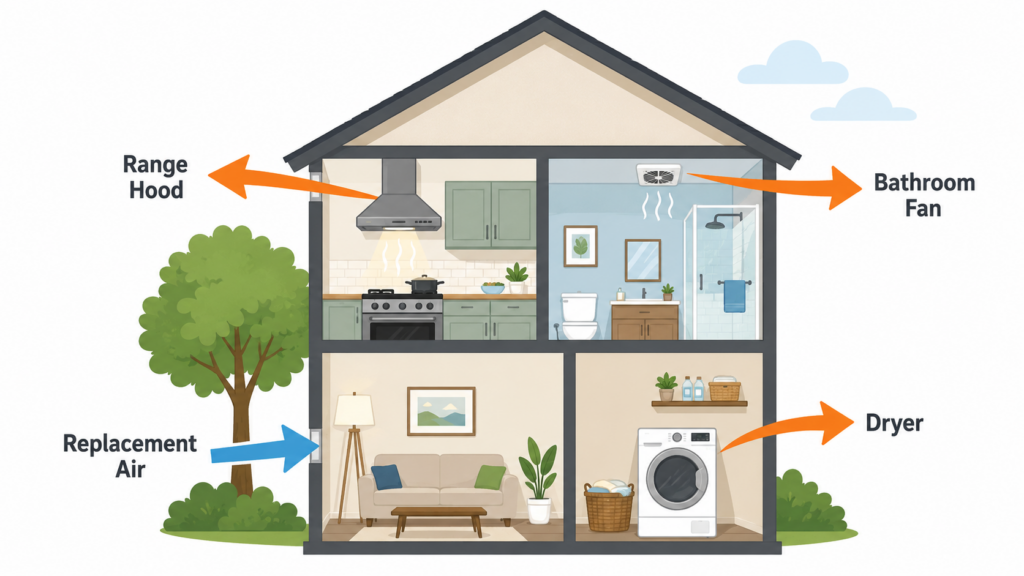
A range hood can be one of several systems removing air from the home.
Other exhaust equipment can include:
That means an HVAC professional may need to consider the whole house, rather than looking only at the CFM printed on the range hood specification.
For example:
Range Hood + Dryer + Bathroom Fans = More Air Leaving the Home
This whole-home perspective becomes particularly important in tightly built houses.
No.
Code compliance is one reason makeup air may need to be addressed, but replacement air can also influence:
When replacement air enters through uncontrolled cracks and gaps, homeowners cannot control where that air originates or where it enters the home.
A properly planned replacement-air strategy gives the project team more control over how the house responds when a powerful exhaust hood operates.
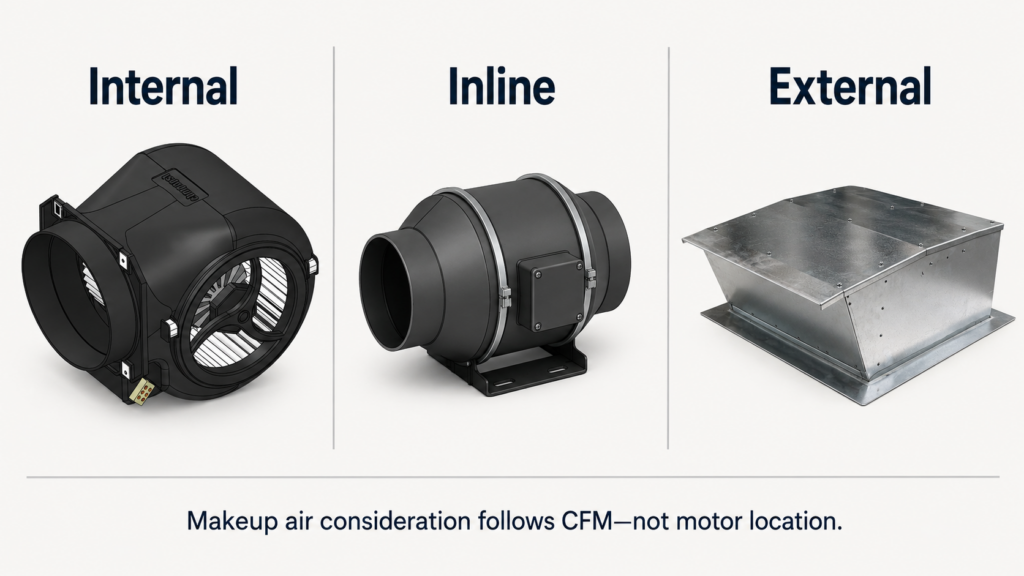
According to Modern Aire, the important connection is CFM.
Whether the hood uses an:
does not, by itself, determine whether makeup air is required.
From an air-balance perspective, what matters is how much air is being exhausted from the building.
Blower location still influences sound, duct routing, and installation, but makeup air planning is primarily tied to the exhaust airflow.
Review Modern Aire’s Motor Options for internal, inline, and external blower configurations.
Not automatically.
The range hood first needs to provide ventilation appropriate for the cooking equipment.
Reducing airflow solely to avoid discussing makeup air can create another problem if the resulting ventilation is not appropriate for the kitchen.
A better planning sequence is:
Modern Aire’s How to Choose guidance can help establish an appropriate starting point for range hood airflow.
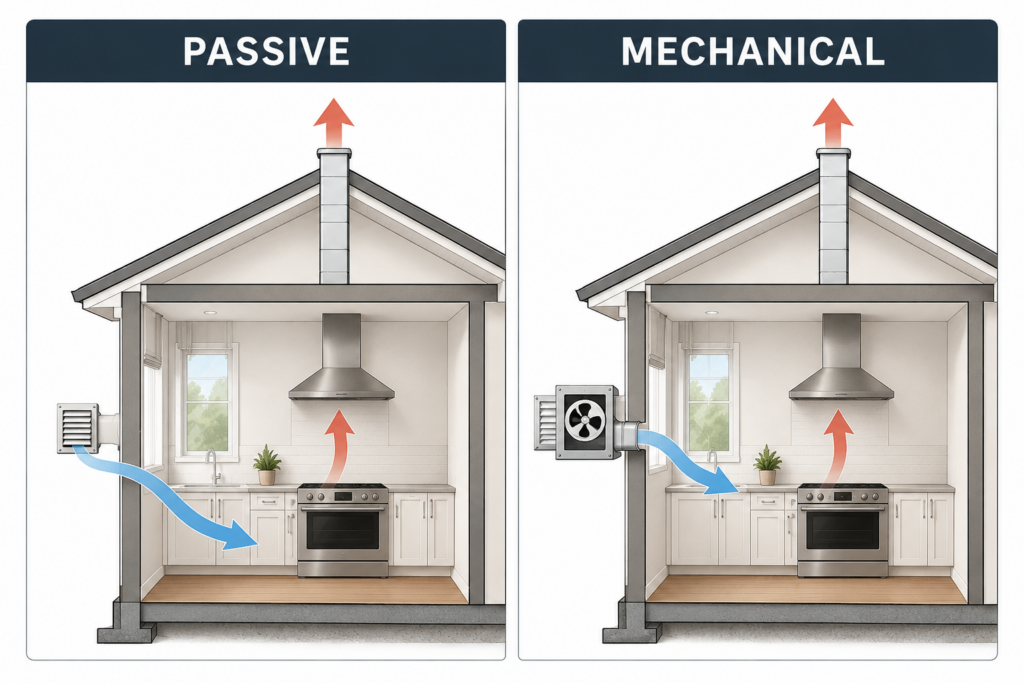
Homeowners may encounter two broad approaches.
A passive system provides a controlled outdoor-air path and uses the pressure created by the exhaust system to bring replacement air into the home.
A mechanical system uses a fan to actively supply replacement air.
Depending on the climate and project, incoming outdoor air may also need to be:
The homeowner generally does not need to design or select this system independently.
The important step is determining whether it is needed before construction is too far along.
Opening a window can allow additional outside air into the home.
Some homeowners may even notice their range hood behaves differently when a window is open.
However, an open window should not automatically be treated as a permanent makeup air solution.
Where code-required makeup air applies, the system may require specific ducts, dampers, controls, or automatic operation.
Opening a window can also be impractical during:
Treat an open window as ventilation behaviour, not a substitute for confirming the project’s mechanical requirements.
Do not assume an existing HRV or ERV automatically solves the range hood makeup air requirement.
An HRV or ERV has its own:
A large range hood may exhaust considerably more air than the home’s balanced ventilation system normally moves.
Whether an existing HRV or ERV can play a role in the replacement-air strategy should be evaluated by an HVAC professional.
This is another reason makeup air needs to be considered as part of the whole home’s mechanical system, rather than as a range hood accessory.
Maybe. A 600 CFM rating alone does not provide a universal yes-or-no answer.
Modern Aire’s experience is that makeup air becomes especially relevant once projects move above approximately 600 CFM, but the final determination depends on the location and project.
At this level, homeowners should proactively ask:
Treat 600 CFM as a conversation point, not a universal cutoff.
As exhaust airflow increases, replacement-air planning becomes increasingly important.
A 900 or 1,200 CFM range hood can be entirely appropriate for the right cooking application, but the home needs to support that level of exhaust.
Before finalizing a high-CFM system, confirm:
| Who Should Help? |
| Modern Aire / dealer |
| HVAC / contractor / local authority |
| HVAC or building professional |
| HVAC professional |
| Qualified professional |
| HVAC professional |
| HVAC professional |
| Builder/contractor |
Modern Aire recommends involving the appropriate professionals rather than trying to resolve the question using a generic online CFM threshold.
Modern Aire or your dealer
Helps determine hood and blower specifications.
HVAC professional
Evaluates exhaust airflow, pressure balance, replacement air, and interaction with the home’s mechanical systems.
Builder or contractor
Coordinates ductwork, electrical work, framing, and construction sequencing.
Local building department or code professional
Confirms which requirements apply to the project.
This separation is important.
Modern Aire can help specify the ventilation equipment, while the broader project team determines how the home will support the air being exhausted.
Before finalizing a higher-CFM range hood, confirm:
Getting these answers early gives the designer, builder, HVAC professional, and homeowner more flexibility.
Modern Aire’s role is to help homeowners and project professionals select an appropriate range hood and blower for the cooking application.
Modern Aire offers wall, island, and custom range hoods along with internal, inline, and external blower options.
Modern Aire can help review:
The project’s HVAC, building-pressure, and makeup air requirements should then be coordinated with the contractor, HVAC professional, and applicable local authority.
That keeps responsibilities clear:
Modern Aire helps determine the ventilation equipment.
Your project team determines how the home should support the air that equipment exhausts.
For project-specific guidance, find a Dealer or contact Modern Aire before the hood and mechanical plans are finalized.
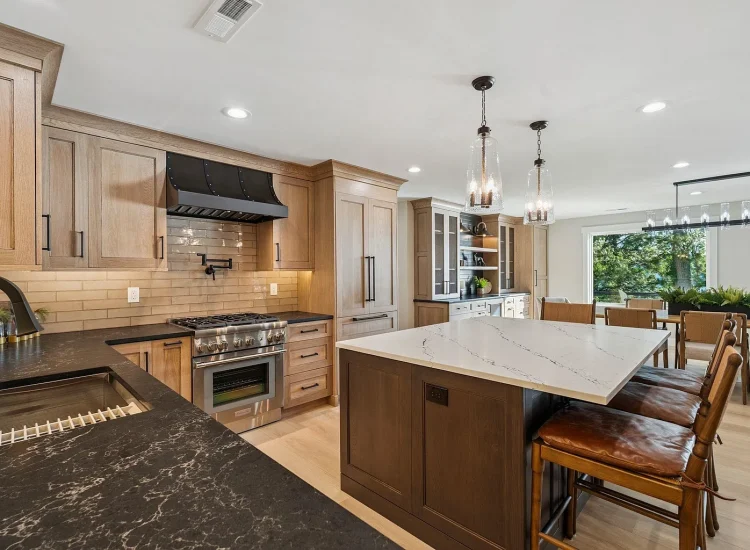
It can help an exhaust system operate in a more balanced environment when insufficient replacement air is creating excessive negative pressure.
Makeup air does not make an undersized or poorly positioned hood perform like a properly designed one, though. Hood sizing, capture, blower selection, and ducting still matter.
Sometimes.
In colder climates, bringing a large volume of untreated outdoor air directly into the home may affect comfort. Depending on the project, an HVAC professional may recommend tempering or conditioning the incoming makeup air.
This is one reason makeup air should be designed for the specific home and climate rather than selected as a generic accessory.
It can be a consideration in hot or humid climates.
If significant outdoor air is being introduced, the HVAC professional may need to consider temperature and humidity as part of the makeup-air design.
The appropriate location depends on the mechanical design and local requirements.
Replacement air should not simply be placed wherever there is available wall space. Its location can affect comfort, airflow, and interaction with the range hood or other mechanical systems.
Have the HVAC professional determine the appropriate location.
No. They are related concepts but serve different purposes.
General ventilation provides ongoing indoor/outdoor air exchange for the home. Makeup air specifically replaces air removed by exhaust equipment such as a high-capacity range hood.
That is why an existing HRV or ERV should not automatically be assumed to provide all the replacement air a large range hood requires.
It may be possible, but adding ducts, dampers, controls, or other mechanical components can be much easier before ceilings, walls, and cabinetry are complete.
That is why Modern Aire recommends raising the makeup-air question during the hood-selection stage.
–
Homeowners do not need to become HVAC engineers to understand makeup air.
The basic principle is simple:
When a range hood exhausts air outdoors, the home has to replace that air somehow.
What happens next depends on the project.
There is no universal rule saying that every 400 CFM or 600 CFM hood requires the same solution. CFM matters, but so do airtightness, other exhaust equipment, applicable fuel-burning appliances, local codes, and the home’s mechanical design.
The most useful questions are:
How much air will my hood exhaust?
How will that air be replaced?
What does my local code require?
Has the HVAC professional reviewed the whole system?
Ask those questions before the range hood, cabinetry, ductwork, and mechanical systems are finalized.
Planning a new kitchen ventilation system? Explore Modern Aire’s Hoods and Motor Options, then find a Dealer or Contact Modern Aire for help selecting the appropriate hood and blower for your project.