
Higher CFM does not automatically mean better range hood performance.
CFM, or cubic feet per minute, describes how much air a blower can move. But effective kitchen ventilation depends on three things working together:
A high-CFM blower can still underperform if the hood does not capture the cooking plume effectively, is mounted incorrectly, or is connected to ductwork that is too small, too long, or overly restrictive.
So if your range hood is not performing as expected, do not immediately assume you need a stronger blower.
A better question is:
What is limiting the airflow or capture in the ventilation system?
CFM stands for cubic feet per minute. It measures the volume of air a blower can move in one minute.
A blower rated at 600 CFM, for example, is designed to move a specified volume of air under its rated test conditions.
CFM matters because the blower needs enough capacity to move cooking contaminants out of the hood. But it is not a complete measure of how well the installed range hood will perform.
A simple way to think about kitchen ventilation is:
Capture gets cooking air into the hood.
CFM moves it through the system.
Ducting carries it outside.
If any one of those steps is compromised, adding a stronger blower may not solve the problem.
The Home Ventilating Institute also recommends considering the ventilation capacity required for the application and using certified airflow ratings when comparing residential ventilation products.
There is no single CFM rating that is right for every kitchen.
The airflow you need depends on factors such as:
A CFM calculation is therefore best used as a starting point, not as the only factor when selecting a range hood blower.
For gas cooking equipment, Modern Aire’s range hood selection guidance uses total BTU (British thermal units) output to estimate the required airflow:
Total BTUs ÷ 100 = Suggested CFM
For example:
90,000 BTUs ÷ 100 = approximately 900 CFM
To use this method, add the maximum BTU ratings of the burners.
Do not rely only on the number of burners. Two ranges of the same width can have significantly different total heat outputs.
Modern Aire recommends approximately 200 CFM for every 12 inches of cooktop width as a starting point for electric and induction cooking.
| Starting Guideline |
| 400 CFM |
| 500 CFM |
| 600 CFM |
| 800 CFM |
These are planning guidelines. The hood dimensions, ductwork, cooking style, and installation still need to support the selected airflow.
When homeowners ask this question, they may mean one of two things.
Use the cooking-equipment guidelines above as a starting point.
That requires measuring airflow.
These numbers are not necessarily the same.
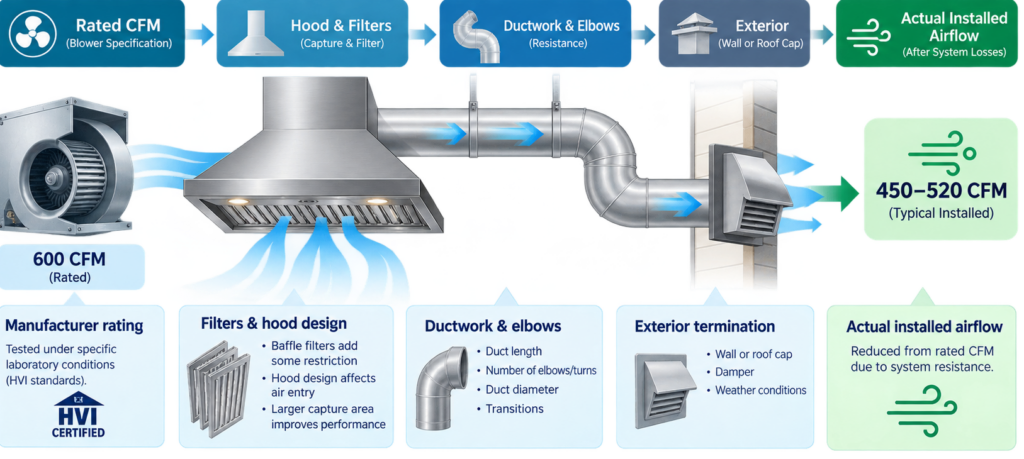
The CFM listed for a blower tells you its rated airflow under specified test conditions.
Once the hood is installed, however, the blower has to move air through:
These components add resistance to airflow.
That is why the airflow produced by a completely installed system can differ from a blower’s maximum airflow rating.
The Home Ventilating Institute’s certification program uses standardized airflow test procedures for residential ventilation equipment, which can help provide a more consistent basis for comparing product ratings.
The basic airflow relationship is:
CFM = Average Air Velocity × Duct Cross-Sectional Area
Air velocity is measured in feet per minute, or FPM, while duct area is measured in square feet.
For example, assume the average air velocity through a duct is measured at 1,200 FPM, and the duct has a cross-sectional area of approximately 0.35 square feet:
1,200 × 0.35 = approximately 420 CFM
That would indicate approximately 420 CFM of airflow through that measurement location.
You can check the blower’s rated CFM through the manufacturer’s specifications.
Accurately measuring actual installed airflow is more complicated because air velocity is not necessarily uniform across the duct.
A single reading taken directly in front of the hood should therefore not be treated as a precise CFM measurement.
If actual airflow needs to be verified, an HVAC or air-balancing professional can use appropriate airflow-measurement equipment and measurement points.
One of the most common misconceptions is that a larger blower can fix almost any ventilation problem.
“Most customers assume that they can solve any ventilation problems with a stronger blower with higher CFM.”
~ Collin Herman
But Modern Aire frequently sees a different issue:
“The problem is typically not the CFM. The problem is more often the mounting height, duct run length, elbows, or duct diameter.”
That is why it is useful to diagnose the symptom before changing the blower.
| What May Be Worth Checking |
| Capture area or mounting position |
| Duct diameter or restriction |
| Duct length or turns |
| Airflow resistance |
| Hood capture |
| Existing ductwork |
This helps answer one of the most common homeowner questions:
“Why is my high-CFM range hood still not pulling smoke?”
The answer may be that CFM was never the main problem.
A blower can only exhaust smoke and grease after they enter the hood.
That means the hood first needs enough capture area to contain the cooking plume before it spreads into the room.
Modern Aire explains:
“Capture area has a similar role to fan power. While you need a fan that can exhaust more smoke/grease than is being created, you also need something large enough to immediately encapsulate the smoke/grease that is being generated.”
Imagine putting a powerful blower inside a hood that does not extend far enough over the cooking surface.
The motor may be capable of moving a large volume of air, but smoke from the front burners can still rise outside the effective capture area.
More CFM cannot fully compensate for air the hood failed to capture.
For detailed guidance on hood width, depth, and mounting position, see How to Size a Range Hood for Your Kitchen rather than treating CFM as a substitute for proper hood sizing.

Yes.
The blower and ductwork need to be compatible.
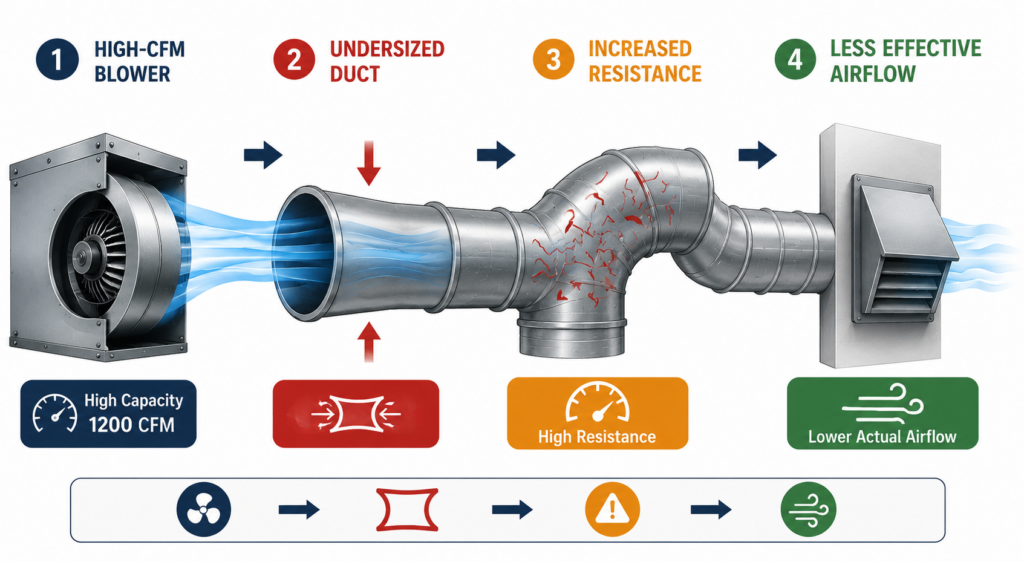
If a high-CFM blower is connected to ductwork that is too small, the duct can restrict airflow and increase resistance within the system.
“CFM overkill is a common issue when ducting has already been run. CFM is absolutely limited by the size of the duct.”
~ Collin Herman
This is particularly relevant during kitchen renovations.
A homeowner may upgrade the blower while keeping existing ductwork concealed behind finished walls or ceilings. If that duct was not designed for the increased airflow, the new blower may not provide the expected improvement.
Modern Aire’s current Motor Options illustrate this relationship:
Modern Aire’s 600 CFM blower specifications also demonstrate how duct design affects airflow. The specification sheet shows decreasing airflow as a 6-inch duct run becomes longer and notes that larger recommended duct sizes reduce static pressure and CFM loss.
This is a much stronger reason to match the blower to the ductwork than simply selecting the highest CFM available.
They can.
Every ventilation system has to overcome resistance as air travels toward the exterior.
Compare two kitchens using the same blower:
Kitchen A: A short, relatively direct duct route to the exterior.
Kitchen B: A longer duct route with several changes in direction.
Even with the same blower rating, the installed systems may not move the same amount of air.
This is why Modern Aire asks homeowners and project professionals to consider duct length, number of turns, and duct size when selecting a blower. Its Motor Options guidance specifically notes that longer duct runs should be reviewed alongside the number of turns, required CFM, and hood model.
The practical takeaway is simple:
A stronger blower cannot eliminate restrictions created elsewhere in the exhaust system.
A blower can have more airflow capacity than the rest of the system can effectively use.
The problem is not the high CFM itself.
The problem is mismatched CFM.
CFM overkill may occur when:
Higher airflow can require additional planning depending on the home and local building requirements. Broan-NuTone’s range hood CFM guide similarly notes that higher-CFM installations may require consideration of makeup air depending on applicable local codes.
Because requirements vary by jurisdiction and home design, makeup-air needs should be confirmed with the appropriate HVAC, building, or code professional.
The goal should not be:
Maximum CFM
It should be:
CFM that matches the cooking equipment, hood, ductwork, and installation.
Not automatically.
CFM is not the only factor that influences how loud a ventilation system feels.
Noise can also be influenced by:
Forcing more air through restrictive ductwork may increase airflow noise even if the blower itself is not unusually loud.
Modern Aire offers internal, inline, and external blower options, allowing blower placement, airflow requirements, ducting, and sound expectations to be considered together.
If reducing kitchen sound is a major priority, blower location should be discussed as part of the complete ventilation design rather than comparing CFM numbers alone.
Before assuming you need more airflow, ask these questions:
If cooking air escapes before entering the capture area, more CFM may not solve the problem.
Mounting position affects how far the cooking plume can spread before reaching the hood.
Compare the proposed blower with its recommended duct diameter before upgrading an existing system.
Longer exhaust paths can introduce additional resistance.
Each turn affects how air travels through the system.
Use the actual range or cooktop requirements as the starting point instead of simply choosing the largest available blower.
If one of these reveals a system issue, correcting that problem may be more effective than adding more CFM.
They do different jobs, and the system needs all of them.
| Main Job |
| Collect smoke, grease, steam, and heat |
| Move the captured air |
| Carry the air outside |
| Allow the system to work together |
A useful way to remember the relationship is:
Capture it. Move it. Exhaust it.
If the hood does not capture the cooking plume, more CFM cannot completely compensate.
If the hood captures the plume but the duct restricts airflow, the blower cannot use its full capacity effectively.
Good range hood performance comes from matching the system rather than maximizing one specification.
Higher airflow can be appropriate when the cooking equipment and cooking habits require it.
Examples may include:
In those situations, more CFM may be useful, provided the hood has enough capture area and the duct system is designed to support the blower.
Higher CFM works best when it is part of the original ventilation plan rather than used later as a fix for a different problem.
Choosing a range hood blower should not begin and end with a CFM number.
Modern Aire helps homeowners and project professionals consider the ventilation system as a whole, including:
Discussing the hood, blower, and ductwork together before cabinetry, walls, and ceilings are finalized can help prevent a powerful blower from being paired with a system that cannot use its airflow effectively.
Explore Modern Aire’s Hoods and Motor Options, then Find a Dealer or Contact Modern Aire for project-specific guidance.
Not exactly. CFM measures the volume of air moved per minute, while “suction” is a more informal way homeowners describe how strongly a hood appears to pull air.
A hood can have a high CFM rating but still struggle with smoke if its capture area, ductwork, or installation limits performance.
Yes. Cooking that regularly produces more heat, smoke, steam, or grease may require greater ventilation capacity than lighter everyday cooking.
Frequent frying, wok cooking, high-heat searing, or cooking on high-output burners are all reasons to discuss ventilation requirements carefully.
See Modern Aire’s How to Choose guide for a starting point.
Usually not. Many cooking tasks do not require the highest fan setting.
Lower speeds may be suitable for lighter cooking, while higher speeds can be used when more smoke, heat, or grease is being produced.
The important consideration is having appropriate airflow available when needed.
They can. Grease and debris buildup can increase resistance through the filtration area and affect how effectively the system moves air.
If a hood previously performed well but airflow has gradually declined, checking and cleaning the filters is a useful troubleshooting step.
Static pressure is the resistance the blower must work against as it moves air through the ventilation system.
Duct size, duct length, elbows, transitions, filters, and exterior terminations can all contribute to resistance.
This is one reason two kitchens using the same blower can deliver different installed airflow.
A dealer, installer, or HVAC professional can review the hood, blower, and duct route together.
If you are selecting a new Modern Aire system, find a Dealer or contact Modern Aire before choosing a larger blower solely to solve an airflow problem.
CFM matters, but it should not be treated as a range hood performance score.
Effective kitchen ventilation requires three jobs to happen successfully:
Capture the cooking plume.
Move the captured air.
Exhaust it through properly planned ductwork.
That is why a higher-CFM blower may not solve a problem caused by poor capture, mounting position, restrictive ductwork, or installation conditions.
Before upgrading to a stronger blower, ask:
Is the problem actually insufficient CFM, or is something preventing the system from using its airflow effectively?
Answering that question can lead to a much better ventilation decision than simply choosing the largest blower available.
Planning a new range hood or troubleshooting a ventilation system? Explore Modern Aire’s Hoods and Motor Options, then Find a Dealer or Contact Modern Aire for project-specific guidance.